|
The advance of Islam was temporarily halted, however, for many years after the adherents of the Muslim faith crossed from southern Mediterranean shores. The forces subsequently battled northward in Spain beyond the Pyrenees Mountains and Muslims terrorized there. It is taught by many historians that Christian forces finally met them in the Battle of Tours on October 10th, 732 A.D. The Christian knights led by Charles Martel thus fought the Muslims in western France, defeating them soundly and subsequently prevented the fall of Christianity as the religious majority in Europe. Many battles in cities afterward forced the Islamic retreat from the Iberian Peninsula during the following years of the century. An American film entitled “El Cid” dramatizes one of the battles fought during this time period. Attacks from Ottoman Muslims in the Levant followed the Catholic Schism of 1054, a religious fallout dividing the Eastern Orthodox and Roman Catholic Churches. The failed Crusades, which were fought in 1096 to 1291 A.D. to free Christian cities in the Holy Land, eventually left that entire geographic area struggling under oppressive Islamic reign. The sack of Constantinople in the spring of 1204 A.D., triggered the historical sequence favoring a relatively short rule by the Byzantine Empire. Later the Muslims fought and conquered that city in 1453 A.D. By that era, the Islamic hordes firmly held the entire southern coastline of Africa, including Algeria, Egypt, Libya, Morocco, Tunisia, and Western Sahara. In the face of this major force and settlement, the monarchy of Spain looked west. By doing so they financed ocean explorations that revealed the American continent. Ibraham believes that |
|
Black Robe Regiment-Allegany-Editorial |

|
A VOICE FOR CHRISTIAN POLITICAL INFLUENCE TODAY! |
|
Christian Implosion... |
|
the Spanish were looking to trade with the Far East and thus circumvent Muslim pirates. During the 15th Century, the Protestant Reformation began through the ministry protest of Jon Huss in Bohemia. After his death by burning at the stake, his resistance was echoed again to the Christian Church some 100 years later by Martin Luther in the early 1500s. Driven by these theological disagreements, political power struggles, and the resulting emergence of several Christian denominations, the turmoil resulted in significant shifts within the Christian faith expression and gradually diminished the corporate strengths of the Catholic Church. As Christians became violently engrossed in Western Europe by wars spurred by both political, economic and theological issues, in Eastern Europe the Battle of Vienna took place. The melee ensued at Kahlenberg Mountain on September 12th, 1683. The city had been besieged by the Ottomans for two months. That crucial battle fought by forces of the Holy Roman Empire, was led by the Habsburg monarchy and the Polish–Lithuanian Commonwealth. Both were commanded by King John III Sobieski of Poland. That victorious battle gained by Christians marked a turning point in the Ottoman–Habsburg wars, which ended a 300-year struggle between the Holy Roman and Ottoman Empires. With that Christian victory, societal turmoil from attacks by Muslim forces in Europe became |
|
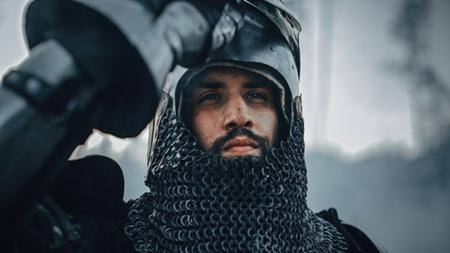
Muslim invasion of the Iberian Peninsula ravaged Spain and Southern France resulted in a major defeat for Islam in 732 A.D. |
|
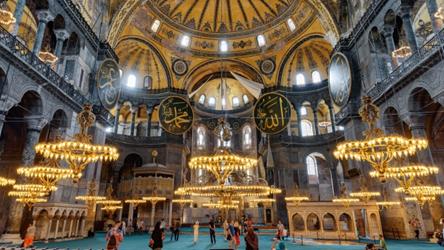
The Muslin military victory over Constantinople, afterward called Istanbul, meant that typically, Christian edifices such as the ornate Hagia Sophia were taken over and dedicated to Islam. |